
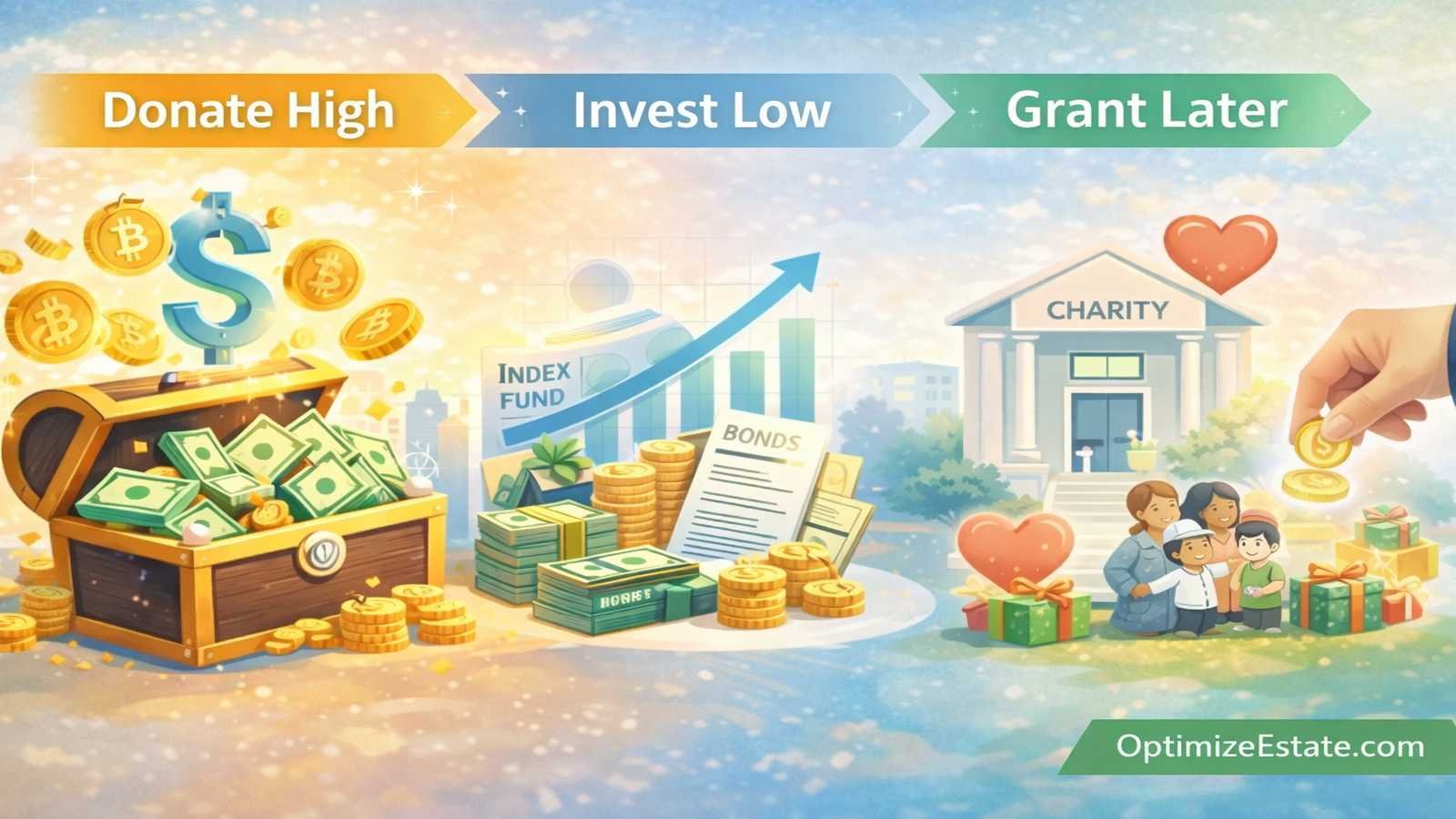
Three Powerful Steps for a Donor-Advised Fund (DAF): Donate High, Invest Low, Grant Later
What a donor-advised fund actually is
A donor-advised fund is a charitable account owned by a public charity (the sponsor). When you contribute assets, the donation is irrevocable and the sponsor becomes the legal owner.
You typically retain advisory privileges to recommend how assets are invested (within sponsor options) and when and to which charities grants are made. This separation of legal ownership and advisory input is what allows an immediate charitable deduction while preserving long-term flexibility.
The two timelines that make DAFs useful
DAFs separate two timelines that do not need to match.
Tax timing: you contribute assets in years when income is high or deductions are especially valuable.
Charitable timing: you recommend grants later, over time, aligned with real charitable needs rather than tax deadlines.
Can DAF assets remain invested before grants are made?
In many cases, yes. There is no universal federal rule requiring rapid distribution. Assets can remain invested as long as they stay under the sponsor’s control and are ultimately used for qualified charitable purposes.
Most sponsors do impose inactivity rules such as periodic grant requirements or minimum balances. These are sponsor policies, not IRS mandates.
Assets you donate vs investments inside the DAF
This distinction is critical and often misunderstood.
Assets commonly donated into a DAF include:
- publicly traded stock
- cryptocurrency or Bitcoin
- vested RSUs or ESPP shares
- private company equity or stock options (sponsor-dependent)
- real estate (accepted by a limited number of sponsors)
- art, collectibles, and other alternative assets (highly sponsor-specific)
Once donated, these assets are often liquidated by the sponsor and converted into stable capital like cash, money market or Stable Coin.
Investment options inside the DAF are typically more traditional and stable, such as:
- equity index portfolios
- broad market exposure
- S&P-style allocations
- bond portfolios
- balanced stock/bond allocations
- ESG-focused funds
- money market or cash pools
Some sponsors now offer expanded menus that may include:
- more targeted equity exposure
- Nasdaq-style growth allocations
- limited crypto-related investment options
Donating an asset does not mean that same asset remains intact inside the DAF. Donation and investment are separate stages governed by different rules.
Using crypto as a practical example
Crypto clearly illustrates the separation between when you donate and how assets are invested after the donation.
The first step is donating at high value. When crypto markets are strong, donating appreciated cryptocurrency allows the contribution to be valued at fair market value at the time of the gift. This is when the charitable deduction is most meaningful, especially in high-income years. The decision here is about donation timing, not trading.
The second step reflects a practical constraint. Most donor-advised fund sponsors do not accept cryptocurrency donations at all. Among the sponsors that do, crypto is almost always liquidated shortly after receipt—often the same day or within hours—and converted into stable assets such as USDC or USDT. This removes volatility risk from the sponsor’s balance sheet and converts the donated asset into deployable capital inside the Donor-Advised Fund.
The third step is long-term investing, not speculation. Once the proceeds are inside the Donor-Advised Fund, the focus shifts to patient allocation. This may include waiting for broader market dislocations or oversold conditions before allocating to long-term holdings such as Bitcoin (where permitted by the sponsor) or diversified equity strategies, and then holding those positions over time. Grants can be made periodically to satisfy sponsor activity rules while allowing the remaining capital to compound.
Seen this way, crypto isn’t being used for trading. It simply makes the three-step Donor-Advised Fund process visible: donate at high value, convert to stable capital, then invest patiently and grant over time.
Alternative assets: where DAF theory meets reality
Alternative assets are where DAF marketing and real execution diverge. Many donors assume “a DAF can take anything,” but the operational reality is sponsor-dependent: acceptance rules, liquidation constraints, appraisal requirements, and timing can vary dramatically.
Advanced Guides & Deep Dives
- How High W-2 Earners Can Cut Taxes by 50%+ by Donating Appreciated Assets (2026) Best when you want to understand the math behind why donating appreciated assets can save more than you might expect.
- Why Selling Before Donating Is a Costly Tax Mistake (Stock & Crypto) Best if you’re about to donate: see the real cost of “sell then give” and how donating appreciated assets can avoid the capital-gains leak.
- DAF vs CRT Deduction Limits Under the Big Beautiful Bill (2026) Best if you’re planning for 2026+: understand how deduction limits and thresholds may change outcomes for high-income donors using DAFs or CRTs.
- DAF vs CRT: Donor-Advised Fund vs Charitable Remainder Trust Best if you’re deciding between structures: a practical comparison of control, complexity, and when a CRT still makes sense versus a DAF.
Frequently Asked Questions
Can donor-advised fund assets stay invested long term before grants are made?
Yes. There is no blanket federal deadline, but most sponsors impose inactivity rules such as minimum annual grants, periodic grant activity, or minimum balances. The practical constraint is sponsor policy, not the IRS.
What’s the difference between donating an asset and investing inside a DAF?
Donations and investments are different stages. Donated assets (like stock or crypto) are typically liquidated, then the proceeds are invested using the sponsor’s approved investment menu (often index portfolios, bonds, and cash pools).
What’s the most common DAF mistake?
Picking a sponsor for brand, not capabilities. The sponsor determines what assets you can donate, how fast they liquidate, what you can invest in afterward, and what grant activity rules apply.