
DAF vs CRT: Donor-Advised Fund vs Charitable Remainder Trust
What DAF and CRT really are (in plain language)
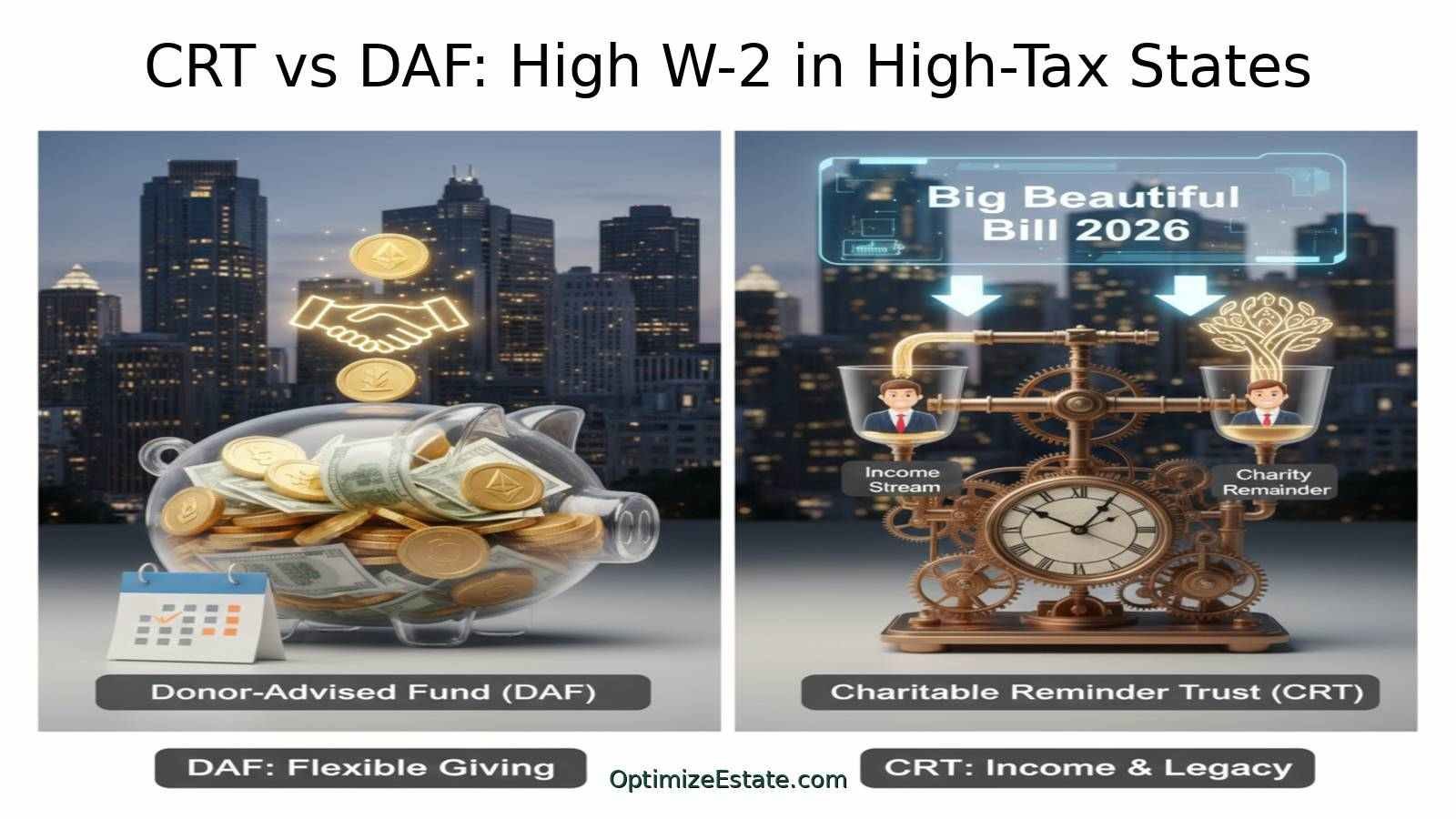
A donor-advised fund (DAF) is a charitable giving account. You contribute assets to the DAF, and then you recommend grants to charities over time. The key benefits for high-income W-2 earners are often: donating appreciated assets instead of selling, avoiding unnecessary tax friction, and controlling when you give to charities without needing to decide every recipient immediately. A charitable remainder trust (CRT) is a trust structure that pays income to a non-charitable beneficiary (often you) for a period of time (or life), and then the remainder goes to charity. The CRT is not primarily a “simple deduction tool.” It is primarily an income stream tool with a charitable remainder. That design difference explains why one isn’t automatically “better.” They solve different problems.The core problem high W-2 earners are trying to solve
Most high W-2 earners in high-tax states are dealing with two painful realities at the same time: 1) ordinary income is taxed heavily Your marginal federal rate is high. Your state rate is also high. The combined bite is substantial. 2) your wealth often sits in appreciated assets Employer stock (including ESPP shares), long-held brokerage positions, equity compensation that becomes appreciated shares, and increasingly crypto. Some also hold real estate, collectibles, or private investments. This matters because the best charitable strategies are often “asset-aware,” not just “donation-aware.” Donating the wrong way creates tax leakage.The DAF approach: why it’s often the default for high-income donors
DAFs tend to win for a simple reason: they match how busy high-income people actually give. They allow you to: - donate appreciated assets without selling first (often the most important move) - potentially claim a charitable deduction in the year of contribution (if you itemize and qualify) - separate the tax decision from the charity decision (contribute now, grant later) - build a repeatable annual workflow This isn’t about “getting rich from donating.” It’s about not paying avoidable taxes on assets you were already willing to give away.The CRT approach: what it’s designed for (and when it can be better)
CRTs can be excellent when the donor’s primary goal is not simply “maximize tax efficiency in a W-2 year,” but rather: - convert an appreciated asset into a structured income stream - spread income out over time (instead of taking it all in one year) - integrate charitable giving into a long-term payout plan If your real goal is income planning, a CRT deserves serious evaluation. It can be a legitimate planning tool for donors who want payments back to themselves (or another beneficiary) while still benefiting charity later. But that strength is also the reason CRTs are not automatically the best fit for the typical high W-2 donor. If your goal is not an income stream, a payout-driven structure can be the wrong kind of complexity.Big Beautiful Bill 2026: why structure matters more now
Big Beautiful Bill 2026 changes the charitable landscape enough that high-income donors should pay attention to how deductions work going forward. The important high-level takeaway for decision-making is this:- Some people who don’t itemize may be able to claim a limited charitable deduction.
- Some itemizers may face new thresholds (a floor tied to AGI).
- Some high earners may see a reduced marginal value for each dollar deducted.
The rules matter, but the practical lesson is bigger: execution and timing matter more in 2026+. Strategies that are easy to execute consistently tend to outperform “clever” structures that never get implemented properly.
How to decide: a simple decision framework
A practical way to choose is to start with your primary outcome. Choose a DAF-first approach if most of these are true:- you want maximum flexibility in which charities you support and when
- you want a repeatable annual workflow
- you plan to donate appreciated assets you’ve held more than one year
- you want to reduce tax friction without building a payout structure
- you want a strategy that is easy to explain and execute
Consider a CRT if most of these are true:
- you want an income stream back to yourself or another beneficiary
- you want a structured payout plan over years
- you’re willing to accept trust-level administration and complexity
- the charitable remainder later fits your legacy plan
What high-income donors often get wrong
The most common mistake isn’t “choosing the wrong tool.” It’s starting from the wrong question. Many people ask: which strategy saves the most taxes? A better question is: which strategy matches what I’m actually trying to do? If your goal is to support charity and reduce taxes in high-income W-2 years using appreciated assets, a DAF is often the most direct and practical tool. If your goal is to convert an appreciated asset into a long-term payout stream and still benefit charity later, CRT might be the right structure.The personal regret (short, but honest)
I donated cash for years because I thought that was the responsible, normal way to give. I didn’t realize that for high W-2 earners with appreciated assets, cash giving can be the expensive way to do something good. It’s frustrating because it’s not an exotic trick. It’s a legitimate, widely used strategy. I just didn’t know the rules, and no one explained them in plain language. If you’ve been doing cash-first giving for years, you’re not alone. Most people do. The point is not guilt. The point is learning the better workflow now.Where the real “premium” value is: administrator fit
This is what people don’t expect: even after you decide DAF vs CRT, the outcome depends heavily on the administrator. Some large DAFs are easy but restrictive or expensive for what certain donors want. Some don’t handle certain assets smoothly. Some don’t support the investment flexibility some donors care about. The same goes for CRT providers: setup costs, administration, and what they’re willing to work with varies a lot.Advanced Guides & Deep Dives
- How High W-2 Earners Can Cut Taxes by 50%+ by Donating Appreciated Assets (2026) Best if you want the core strategy and the math: why donating appreciated assets can stack ordinary-income savings plus avoided capital gains for a 50%+ effective benefit.
- Three Powerful Steps for a Donor-Advised Fund: Donate High, Invest Low, Grant Later Best if you want a simple operating framework: contribute in a high-income year, invest inside the DAF, and grant over time without rushing charity choices.
- Why Selling Before Donating Is a Costly Tax Mistake (Stock & Crypto) Best if you’re about to donate: see the real cost of “sell then give” and how donating appreciated assets can avoid the capital-gains leak.
- DAF vs CRT Deduction Limits Under the Big Beautiful Bill (2026) Best if you’re planning for 2026+: understand how deduction limits and thresholds may change outcomes for high-income donors using DAFs or CRTs.
- How High W-2 Earners Can Cut Taxes by 50%+ by Donating Appreciated Assets Best if you want to understand the math behind why donating appreciated assets can save far more than you might expect.
External Verified Resources
-
IRS Publication 526: Charitable Contributions
The official IRS guide on deduction limits for cash vs. appreciated property.
-
Legislative Summary: Big Beautiful Bill 2026
A technical breakdown of the 2026 tax code changes and new AGI thresholds.
-
National Philanthropic Trust: DAF vs. Private Foundation
A deep dive into why DAFs have become the preferred vehicle over traditional foundations.
FAQ
Is a donor-advised fund (DAF) or a charitable remainder trust (CRT) better if I want to donate appreciated stocks?
If your primary goal is tax-smart giving with flexibility and you want to donate appreciated stock without building a payout structure, many high W-2 earners use a DAF-first approach. If your primary goal is turning an appreciated asset into an income stream for yourself or another beneficiary and leaving the remainder to charity later, a CRT may fit better.
Can I donate appreciated stock from ESPP or equity compensation?
Many donors can donate appreciated shares held in a brokerage account, including shares acquired through ESPP or equity compensation that have become transferable shares. The operational details depend on how the shares are held and the policies of the DAF or CRT provider.
Does Big Beautiful Bill 2026 change whether I should use a DAF or CRT?
Big Beautiful Bill 2026 can affect how valuable charitable deductions are and when they apply, which makes timing and execution more important. The best choice still comes down to your primary outcome: flexible giving and simplicity (often DAF) versus structured payouts with a charitable remainder later (CRT).