
2026 DAF Deduction Limits Under Trump’s One Big Beautiful Bill: What High W-2 Earners Need to Know
If you’re a high W-2 earner in California or New York, a donor-advised fund (DAF) is still one of the cleanest ways to reduce federal taxes while supporting causes you care about. What changes in 2026 is the “how much benefit do I actually get?” math around itemized deductions—so the same donation can produce less tax benefit if you don’t plan around the new rules.
A small personal note (brief): I used to treat charitable giving like a simple shortcut—donation × marginal rate. The more I modeled real outcomes in high-tax states, the more I realized the edge comes from deduction mechanics, timing, and asset choice—not just giving more.
These 2026 changes are tied to the One Big Beautiful Bill Act signed into law in 2025 (Public Law 119-21), with multiple provisions affecting deductions beginning in 2026.
What changes in 2026 that matters for DAF planning
Two specific changes under the One Big Beautiful Bill Act are especially important for itemizers:
New 0.5% AGI floor for itemized charitable deductions
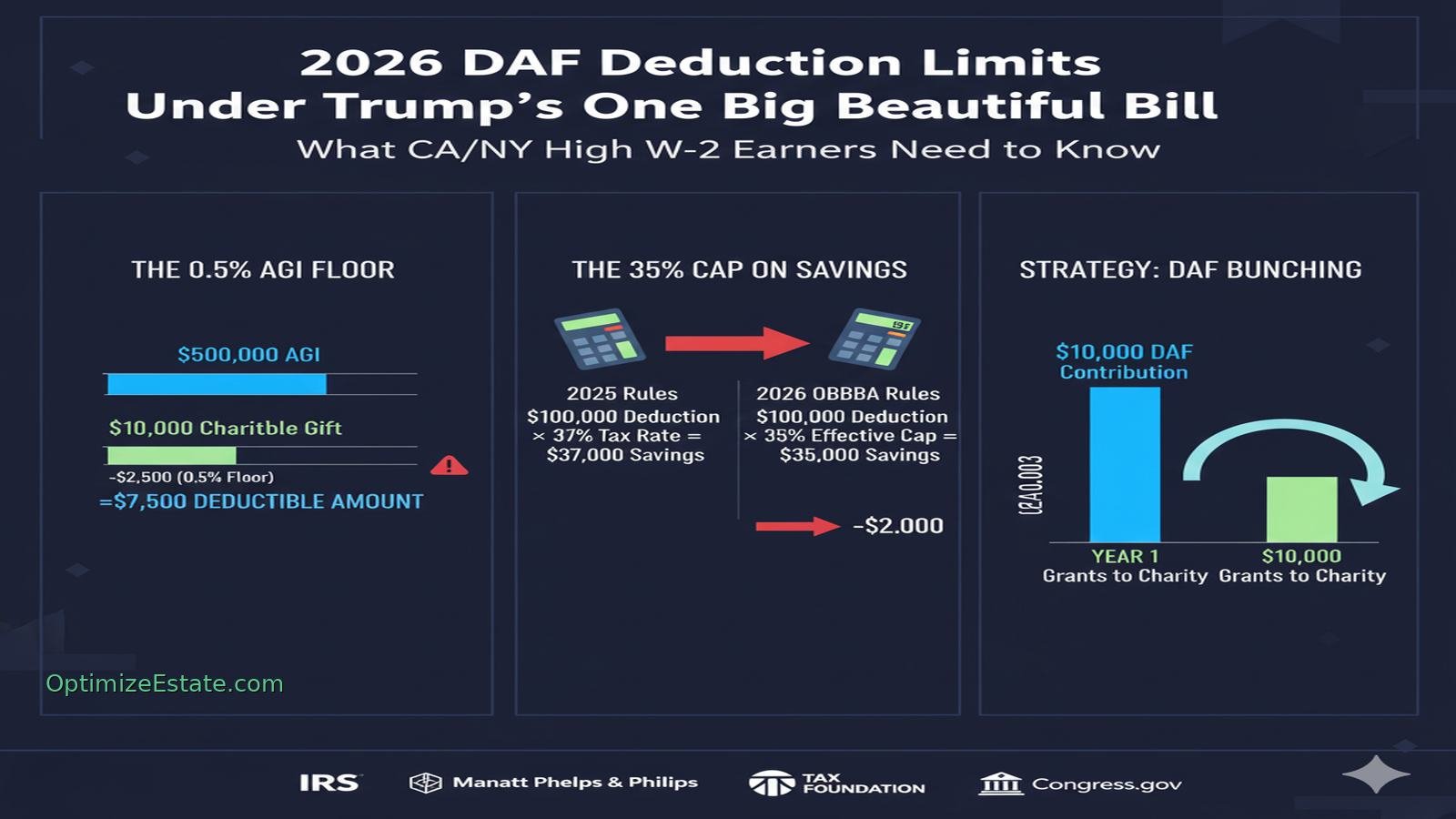
Starting in 2026, itemized charitable deductions apply only to the extent your total qualifying charitable gifts exceed 0.5% of your adjusted gross income (AGI).
New limitation on the value of itemized deductions for top-bracket taxpayers
Beginning in 2026, taxpayers above the top-rate threshold face new restrictions on itemized deductions; many summaries describe this as effectively capping the value of itemized deductions at 35% for those in the 37% bracket.
Why this matters: DAFs don’t become “worse” in 2026. But the rules change how much the deduction is worth and how much of your giving actually counts as deductible.
The baseline DAF deduction limits still apply
Separate from the new 2026 floor/cap, the long-standing percentage-of-AGI limits still control how much you can deduct in a given year, depending on what you donate:
- cash contributions to public charities (including many DAF sponsors): generally up to 60% of AGI
- long-term appreciated property (held more than one year): generally up to 30% of AGI
- unused amounts can generally carry forward up to five years
This is still the core engine of DAF planning: contribute in a high-income year (take the deduction then), and grant to charities over time.
How the 0.5% AGI floor hits high W-2 earners
The new rule is simple: the first 0.5% of AGI in charitable giving doesn’t count toward your itemized charitable deduction.
Example:
AGI = $500,000
0.5% of AGI = $2,500
If you donate $10,000 total, the deductible portion is $7,500 (assuming other rules are met)
Practical impact for CA/NY high W-2 households:
- Small or moderate annual giving can become less tax-efficient unless you clear the floor by a meaningful margin.
- It increases the importance of planning donation timing instead of “same amount every year.”
Planning move that often wins: bunching with a DAF
A DAF lets you contribute in one large “bunch year” (so you clear the 0.5% floor easily), then grant steadily for multiple years. This is especially useful if your W-2 spikes (bonus year, RSU vest year, severance year).
| Tax Provision | 2025 (Old Rules) | 2026 (OBBBA Rules) |
|---|---|---|
| SALT Deduction Cap | $10,000 | $40,400 (Phases down above $505k income) |
| Charitable Floor (Itemized) | None (1st dollar deductible) | New 0.5% AGI Floor |
| Charitable Benefit Cap | Marginal Rate (up to 37%) | New Capped at 35% Value |
| Universal Donation | $0 (Non-itemizers) | $1,000 (S) / $2,000 (J) Above-the-line deduction |
| Standard Deduction (Joint) | $31,500 | $32,200 |
| Child Tax Credit | $2,000 (Partially Refundable) | $2,200 (Includes $5,000 Refundable Adoption Credit) |
How the 35% limitation changes “savings per dollar”
If you’re in the top bracket, you may be used to thinking “each $1 of deduction saves me 37 cents federally.” Under the One Big Beautiful Bill Act’s new itemized deduction restrictions, many analyses describe an effective cap of 35 cents per dollar for top-bracket taxpayers starting in 2026.
This sounds small, but it compounds on large deduction years. When you’re talking about a six-figure DAF contribution, a couple cents per dollar becomes real money.
The 2026 DAF strategy that matters most
Treat “timing” as the strategy (not the DAF itself)
In 2026, timing matters more because:
- the 0.5% floor penalizes smaller donation totals relative to AGI
- the top-bracket limitation reduces the per-dollar value of itemized deductions
What to do:
- Identify your “peak income year” (or years) and consider a larger DAF contribution in that period.
- Use the DAF to smooth your actual charitable giving over time.
Put appreciated assets at the center of your plan
For high earners, the biggest incremental win often comes from avoiding capital gains by donating appreciated assets directly (stock/ESPP/crypto) rather than selling and donating cash.
Contribution vs grant timing is still the DAF superpower
The deduction happens when you contribute to the DAF (and follow substantiation rules), not when you send grants later. That means you can:
- take a deduction in the year it helps most
- still support charities on your preferred schedule
Don’t lose the deduction to paperwork
This is unglamorous but critical in high-dollar giving:
- larger non-cash contributions can trigger specific forms and substantiation requirements
- some non-cash gifts may require qualified appraisals depending on the asset and value
IRS Publication 526 is the practical baseline for substantiation and deduction mechanics.
IRS.gov: Publication 526 →
Advanced Guides & Deep Dives
- How High W-2 Earners Can Cut Taxes by 50%+ by Donating Appreciated Assets (2026) Best if you want the core strategy and the math: why donating appreciated assets can stack ordinary-income savings plus avoided capital gains for a 50%+ effective benefit.
- Three Powerful Steps for a Donor-Advised Fund: Donate High, Invest Low, Grant Later Best if you want a simple operating framework: contribute in a high-income year, invest inside the DAF, and grant over time without rushing charity choices.
- Why Selling Before Donating Is a Costly Tax Mistake (Stock & Crypto) Best if you’re about to donate: see the real cost of “sell then give” and how donating appreciated assets can avoid the capital-gains leak.
- DAF vs CRT: Donor-Advised Fund vs Charitable Remainder Trust Best if you’re planning for 2026+: understand how deduction limits and thresholds may change outcomes for high-income donors using DAFs or CRTs.
FAQ
How long can money stay in a DAF before I recommend grants?
In most cases, there is no federal “use it by” deadline that forces you to grant everything within a set number of years, but DAF administrators often have their own minimum grant activity or account balance policies.
Practically, you can keep funds invested and recommend grants over time, as long as you follow your administrator’s rules and only recommend grants to IRS-qualified charities.
Can I donate appreciated stock or crypto to a DAF instead of cash?
Yes.
Donating appreciated assets is often the highest-impact move because it can avoid capital gains tax that would reduce what reaches charity if you sold first. A DAF can be especially useful when the charity you want to support cannot accept the asset directly, or when you want to separate deduction timing (contribute now) from grant timing (give later).
What documentation do I need for a large non-cash donation?
For larger non-cash gifts, you may need additional substantiation beyond a standard receipt.
Depending on the asset type and value, that can include Form 8283 and, for certain assets over certain thresholds, a qualified appraisal by a qualified appraiser. Good documentation is critical because the tax benefit can be reduced or disallowed if substantiation is incomplete.